
T1 Tool Steel Manufacturer in India: Maximize Cutting Efficiency
Cutting efficiency depends on more than machine speed, tool geometry and operator skill. The steel used to manufacture the cutting tool influences how effectively its edge withstands heat, abrasion and repeated mechanical loading.
Inconsistent hardness, premature softening, rapid wear and edge chipping can shorten tool life and interrupt production. Selecting a capable T1 tool steel manufacturer in India is therefore an important procurement decision for toolmakers seeking reliable cutting performance, dimensional consistency and longer operating cycles.
T1 is one of the original tungsten-based high-speed steels. Its combination of wear resistance, resistance to softening, toughness and deep-hardening response makes it relevant for demanding cutting and forming tools.
What is T1 Tool Steel?
T1 is a tungsten high-speed tool steel designated AISI T1 and DIN 1.3355. Toolman describes it as an air- or oil-hardening grade with good overall performance, effective cutting capability and a strong response to deep hardening.
Its high tungsten content supports performance under heat and wear. Unlike ordinary tool steels that may lose hardness as the cutting edge becomes hot, T1 is designed to retain useful cutting characteristics at elevated temperatures.
T1 Steel at a Glance
|
Parameter |
Toolman-Published Detail |
|
Steel category |
Tungsten high-speed tool steel |
|
AISI designation |
T1 |
|
DIN designation |
1.3355 |
|
Hardening method |
Air or oil hardening |
|
Main characteristics |
Wear resistance, resistance to softening, toughness and cutting capability |
|
Annealed hardness |
230–300 HBW |
|
Quenched and tempered hardness |
62–66 HRC |
|
Typical uses |
Cutting, drilling, tapping, reaming and broaching tools |
How T1 Steel Improves Cutting Efficiency
Resistance to Softening
Friction generates considerable heat at the cutting edge. If the steel softens rapidly, the edge can lose its profile, increase cutting resistance and produce an inconsistent finish. Toolman identifies very high resistance to softening as one of T1 steel’s principal characteristics.
High Wear Resistance
A worn edge requires greater cutting force and may compromise dimensional accuracy. T1’s wear resistance helps the tool maintain its geometry through longer production cycles, reducing the frequency of sharpening or replacement.
Hot Hardness and Edge Retention
Toolman describes T1 as possessing high red hardness and the ability to maintain its cutting edge under high-temperature conditions. This makes the grade useful in high-speed cutting, drilling, milling and tapping operations where heat accumulates around the working edge.
Toughness and Deep Hardening
Hardness alone does not guarantee tool life. Cutting tools may encounter vibration, interrupted cuts and sudden loading. T1 combines cutting hardness with good toughness, while its deep-hardening response supports more consistent properties through the tool section.
The correct balance remains important. Excessive hardness may increase chipping risk, while insufficient hardness can accelerate wear and edge deformation.
Chemical Composition of Toolman T1 Steel
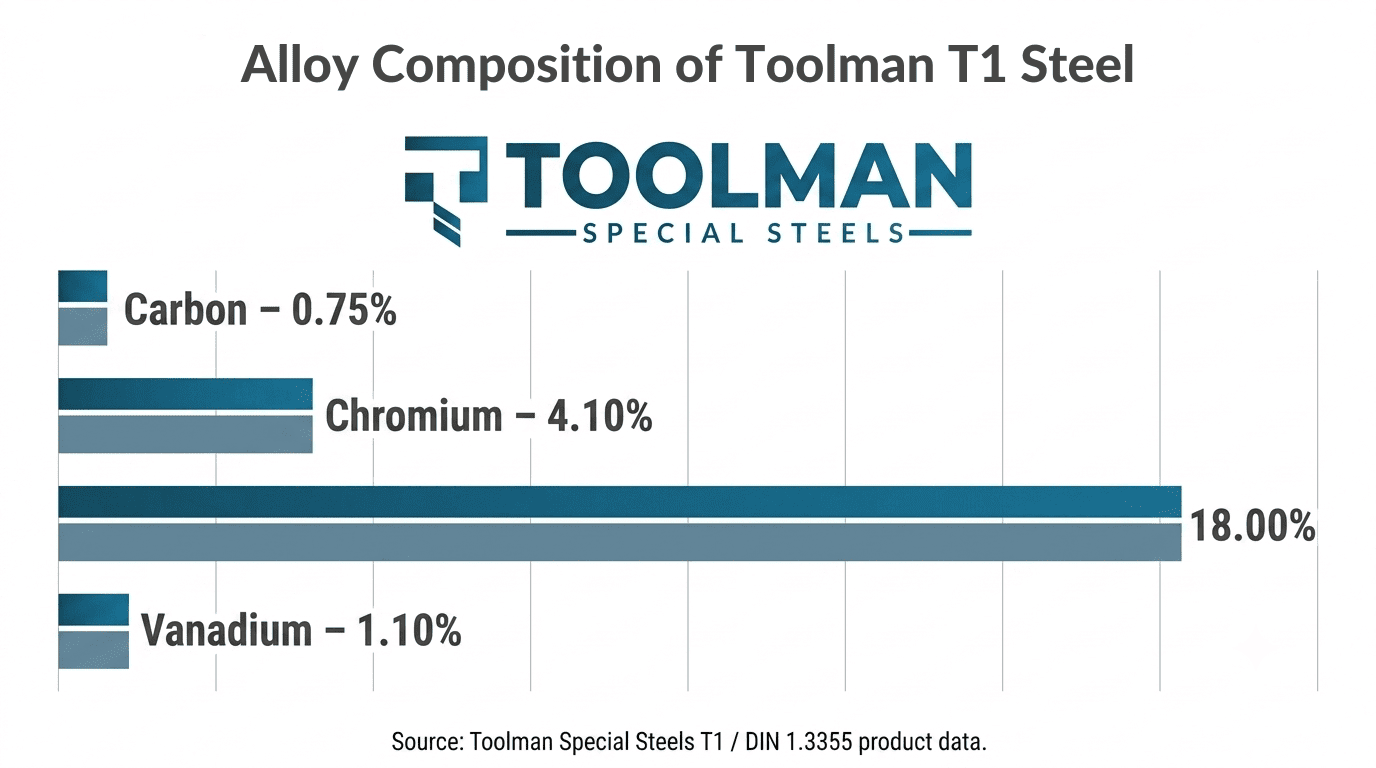
Toolman publishes the following nominal composition for its T1 grade.
|
Element |
Published Value |
|
Carbon |
0.75% |
|
Chromium |
4.10% |
|
Tungsten |
18.00% |
|
Vanadium |
1.10% |
|
Molybdenum |
Not listed |
|
Cobalt |
Not listed |
Carbon supports hardness and carbide formation. Tungsten is the dominant alloying element and contributes to hot hardness and resistance to softening. Chromium supports hardenability, while vanadium contributes to wear-resistant carbide formation and cutting-edge durability.
Published Technical Properties
|
Property |
Toolman-Published Value |
|
Annealed hardness |
230–300 HBW |
|
Quenched and tempered hardness |
62–66 HRC |
|
Density |
8.7 g/cm³ |
|
Modulus of elasticity at 20°C |
217 kN/mm² |
|
Thermal expansion coefficient at 500°C |
11.8 × 10⁻⁶/°C |
|
Thermal expansion coefficient at 600°C |
12 × 10⁻⁶/°C |
|
Thermal conductivity at 20°C |
19 W/m·K |
The hardness range supports T1’s use in cutting tools, while its thermal data assists engineers in evaluating heat movement and dimensional behaviour. Final properties will still depend on the tool section, geometry and heat-treatment execution.
Heat Treatment of T1 Tool Steel
Heat treatment converts the supplied material into a functioning cutting tool. Toolman publishes the following process guidance.
|
Process |
Temperature |
Published Procedure |
|
Soft annealing |
850–900°C |
Cool slowly in the furnace to approximately 700°C, then air cool |
|
Stress relieving |
600–700°C |
Hold for two hours and cool in still air |
|
Hardening for higher toughness |
1190–1210°C |
Use where toughness is prioritised |
|
Hardening for higher hardness |
1210–1240°C |
Use where greater hardness is required |
|
Tempering |
540–620°C |
Hold for at least two hours per 25 mm thickness; triple tempering is normally used |
|
Final hardness |
62–66 HRC |
Depends on the selected treatment route |
These figures should be treated as general technical guidance. Tool size, cross-section, cutting conditions, distortion risk and the required hardness–toughness balance must be reviewed before finalising a treatment cycle.
Typical T1 Tool Steel Applications
|
Application |
Relevant T1 Characteristic |
|
Turning tools |
Hot hardness and edge retention |
|
Planing and slotting tools |
Wear resistance and cutting capability |
|
Taps |
Hardness and profile stability |
|
Spiral drills |
Cutting-edge durability |
|
Threading dies |
Profile retention |
|
Profile cutting tools |
Dimensional and edge stability |
|
Broaching tools |
Deep-hardening response |
|
Reamers |
Hardness and dimensional accuracy |
These applications are listed on Toolman’s official T1 product page. Its published T1 article also identifies twist drills, end mills, slitting cutters, punches, dies and lathe tools as relevant uses.
Why Manufacturer Quality Affects Tool Performance
Chemical composition is only one part of cutting-tool performance. Melting control, refining, forging, rolling, annealing, machining and inspection determine how consistently the alloy is converted into usable tool steel.
Toolman’s integrated infrastructure includes induction melting, precision rolling, hot and open-die forging, ESR units, bar peeling, finishing facilities and metallurgical laboratories. Its T1 material undergoes quality control, with certificates and test reports available on request.
|
Cutting Problem |
Possible Material-Related Contributor |
|
Rapid edge wear |
Insufficient hardness or inconsistent carbide structure |
|
Softening in operation |
Inadequate hot-hardness response |
|
Edge chipping |
Unsuitable hardness–toughness balance |
|
Distortion |
Residual stress or incorrect heat treatment |
|
Soft spots |
Non-uniform hardening response |
|
Variable tool life |
Inconsistent processing or supply condition |
These factors are possible contributors rather than automatic diagnoses. Tool geometry, cutting speed, lubrication, workpiece material and machine condition must also be considered.
Toolman T1 Manufacturing Range
|
Product Form |
Published Size Range |
Condition |
|
Rounds |
6–14 mm |
CG |
|
Rounds |
15–50 mm |
HRAP |
|
Rounds |
52–405 mm |
FAT |
|
Squares |
7.2–40 mm listed sizes |
HRA |
|
Squares |
52–305 mm |
FA |
|
Flats |
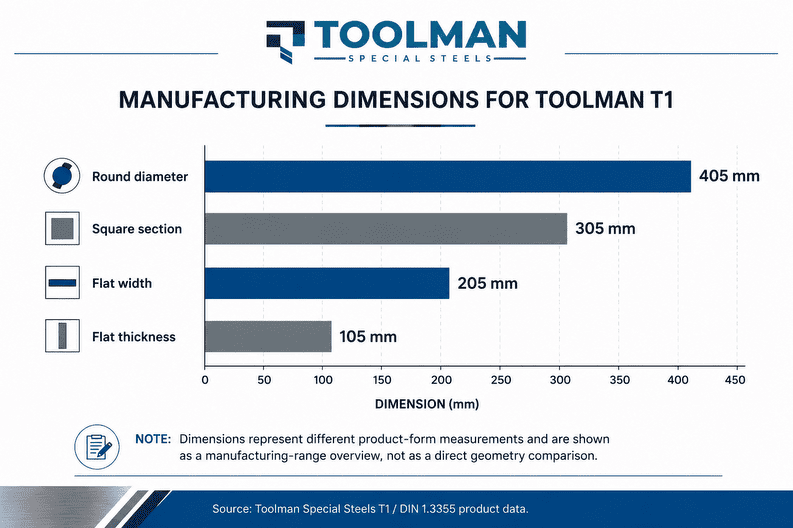
5–32 mm thick × 21–105 mm wide |
HRA |
|
Flats |
32–105 mm thick × 40–205 mm wide |
FA |
The published range covers small precision stock and substantially larger forged sections. Exact availability, tolerance, finish and supply condition should be confirmed at the enquiry stage.
How to Choose a T1 Tool Steel Manufacturer in India
A technically complete enquiry should cover more than price and delivery time.
Confirm:
- AISI T1 / DIN 1.3355 grade designation
- Chemical composition and heat traceability
- Required round, square or flat dimensions
- Annealed condition and hardness
- Intended quenched-and-tempered hardness
- Testing and certification requirements
- Cutting application and workpiece material
- Custom cutting, machining or finishing needs
- Packaging, documentation and delivery destination
Share the operating conditions and any previous tool failure with the manufacturer. This helps connect material selection and supply condition with the actual cutting requirement.
Related High-Speed Steel Grades
Toolman’s high-speed steel portfolio includes M2, M3, M7, M35, M42, ABC III, T1, T4, T15 and T42.
|
Grade |
General Selection Context |
|
M2 / DIN 1.3343 |
General-purpose HSS balancing toughness and wear resistance |
|
M35 / DIN 1.3243 |
Cobalt-alloyed HSS with improved red hardness |
|
M42 / DIN 1.3247 |
Premium cobalt HSS for demanding cutting conditions |
|
T4 / DIN 1.3255 |
High-tungsten HSS with enhanced toughness |
|
T15 / DIN 1.3202 |
Tungsten-cobalt grade offering strong edge retention |
|
T42 / DIN 1.3207 |
Cobalt-rich grade for high-performance tooling |
The correct grade depends on cutting temperature, workpiece hardness, abrasion, impact loading, desired tool life and the acceptable balance between wear resistance and toughness.
Why Source T1 From Toolman?
Toolman manufactures T1 within an integrated special-steel operation covering melting, forging, rolling, heat treatment, machining and metallurgical inspection. The company publishes multiple T1 product forms and sizes and offers certificates and test reports on request.
Toolman has operated in the steel sector since 1957 and reports an annual production capacity exceeding 12,000 tonnes across more than 50 grades. It supplies customers in India and export markets including the USA, Japan, China, Europe and Turkey.
Need T1 Steel for Your Cutting Tools?
Contact us and share your required size, quantity, product form, supply condition and application with Toolman Special Steels.
Call: +91 98155 25326 / +91 95018 53532
Email: indiatoolman@gmail.com
Download T1 Datasheet
Frequently Asked Questions
1. What is T1 tool steel?
T1 is a tungsten-based high-speed tool steel designated AISI T1 and DIN 1.3355. It offers wear resistance, resistance to softening, good toughness and a deep-hardening response.
2. What hardness can Toolman T1 achieve?
Toolman publishes an annealed hardness of 230–300 HBW and a quenched-and-tempered hardness of 62–66 HRC.
3. What is T1 steel commonly used for?
Toolman lists turning tools, taps, spiral drills, threading dies, profile cutters, broaches, reamers, and planing and slotting tools.
4. Why is T1 suitable for cutting tools?
Its wear resistance, hot hardness and resistance to softening help the cutting edge retain hardness and geometry when exposed to friction, heat and repeated cutting loads.
5. What should a T1 steel enquiry include?
Include the grade, dimensions, quantity, product form, supply condition, required hardness, intended application, testing needs, certification requirements and delivery destination.
Ready to upgrade? Contact our team today for expert guidance and support.
Contact