Toolman Special Steels is proud to produce and offer 1.2767 steel. 1.2767 (45NiCrMo16) is a high-carbon, high-chromium tool steel that contains nickel for enhanced toughness. It is known for its excellent toughness and good wear resistance, making it suitable for high-impact applications. This nickel containing cold work tool steel has good hardenability and toughness, and can be polished, photo-etched, and etched. It is applied for forged tools, molds of various shapes and dimensions, and hot forged as well as stamping tools.
Steel Properties
-
Good hardenability
-
Dimensionally stable steel with high toughness and resistance to impact and compressive stress.
-
High impact resistance
-
Good wear resistance
-
High Compressive strength
-
Proper machinability
Ability for polishing, photo-etching and erosion treatment
Chemical Composition
| Element | Min (%) | Max (%) |
|---|---|---|
| C | 0.40 | 0.50 |
| Si | 0.10 | 0.40 |
| Mn | 0.15 | 0.45 |
| P | - | 0.030 |
| S | - | 0.030 |
| Cr | 1.20 | 1.50 |
| Mo | 0.15 | 0.35 |
| Ni | 3.80 | 4.30 |
Mechanical Properties
| Property | Value |
|---|---|
| Annealing Hardness (HBW) | 262 max |
| Quenching and Tempering Hardness (HRC) | 52 min |
Physical Properties
| Property | Value |
|---|---|
| Density (g/cm³) | 7.84 |
Modulus of Elasticity
| Temperature (°C) | GPa |
|---|---|
| 20 | 190 |
Thermal Properties
| Temperature (℃) | Thermal Expansion Coefficient (10^-6/℃) |
|---|---|
| 20-100 | 11.7 |
Thermal Conductivity
| Temperature (℃) | Thermal Conductivity (W/m•K) |
|---|---|
| 20 | 28 |
HEAT TREATMENT AND PROCESSES
Heat treatment
| HEAT TREATMENT CONDITIONS |
|---|
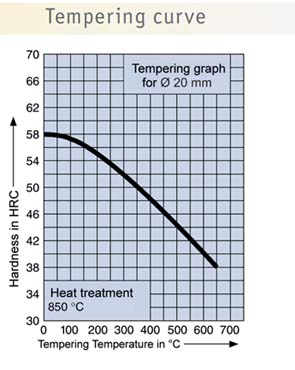
| 850℃ Oil Cooling +180℃ Air Cooling |
| Tempering °C | HRC |
|---|---|
| 100 | 57 |
| 200 | 56 |
| 300 | 51 |
| 400 | 48 |
| 500 | 44 |
| 600 | 40 |
| 700 | 38 |
Applications
-
Mould plates and inserts for the processing of thermoplastics and thermosets, especially for high gloss polishes, e.g. for transparent melts and components with high surface requirements, mould components with high compressive and flexural stresses, embossing tools and other uses for which the above requirements are needed.
-
Cutlery dies
-
Cutting tools for thick material
-
Billet-shear blades
-
Drawing jaws
-
Massive embossing and bending tools,
-
Plastic moulds, reinforcements.
-
Stamping tool.
Quality Assurance
Our 1.2767 steel undergoes rigorous testing and quality control to meet international standards, ensuring consistent performance and reliability. Certificates and test reports are available upon request. Feel free to reach out to us for more information on our 1.2767 steel products or to discuss your specific requirements. We're dedicated to providing top-quality steel solutions that meet your needs and exceed your expectations.
Manufacturing Range
| Products | Diameter (mm) |
|---|---|
| Hot Rolled bar | 8 - 65 |
| Forged and Turned bars | 65.2 - 500 |
| Forged Square Bars | 50 - 500 |
Flats
| THICKNESS | WIDTH |
|---|---|
| 6.00 mm - 410.00 mm | 20.00 mm - 700.00 mm |
Frequently Asked Questions
We manufacture DIN 1.2767 / 45NiCrMo16 as a nickel-containing cold work tool steel with high toughness, good wear resistance and good hardenability. Its nickel content supports performance in tooling exposed to impact and compressive stress.
Our DIN 1.2767 steel offers:
- Good hardenability
- High toughness
- High impact resistance
- Good wear resistance
- High compressive strength
- Good machinability
- Dimensional stability
- Suitability for polishing, photo-etching and erosion treatment
We supply DIN 1.2767 for:
- Mould plates and inserts
- High-gloss plastic mould components
- Cutlery dies
- Cutting tools for thick materials
- Billet-shear blades
- Drawing jaws
- Heavy embossing and bending tools
- Plastic moulds and reinforcements
- Stamping tools
It is also used for forged tools and moulds of different shapes and dimensions.
Our DIN 1.2767 steel has:
- Maximum annealed hardness: 262 HBW
- Minimum quenching and tempering hardness: 52 HRC
Our tempering data shows approximately 57 HRC at 100°C, 56 HRC at 200°C and 40 HRC at 600°C.
Our typical composition includes:
- Carbon: 0.40–0.50%
- Chromium: 1.20–1.50%
- Nickel: 3.80–4.30%
- Molybdenum: 0.15–0.35%
- Manganese: 0.15–0.45%
- Silicon: 0.10–0.40%
Phosphorus and sulphur are limited to 0.030% each.
Our published heat-treatment condition uses:
- Hardening at 850°C
- Oil cooling
- Air cooling at 180°C
The final tempering temperature is selected according to the required hardness, with our tempering data covering 100–700°C.
We manufacture:
- Hot-rolled bars: 8–65 mm
- Forged and turned bars: 65.2–500 mm
- Forged square bars: 50–500 mm
- Flats: 6–410 mm thickness
- Flat widths: 20–700 mm
We also provide certificates and test reports on request.
