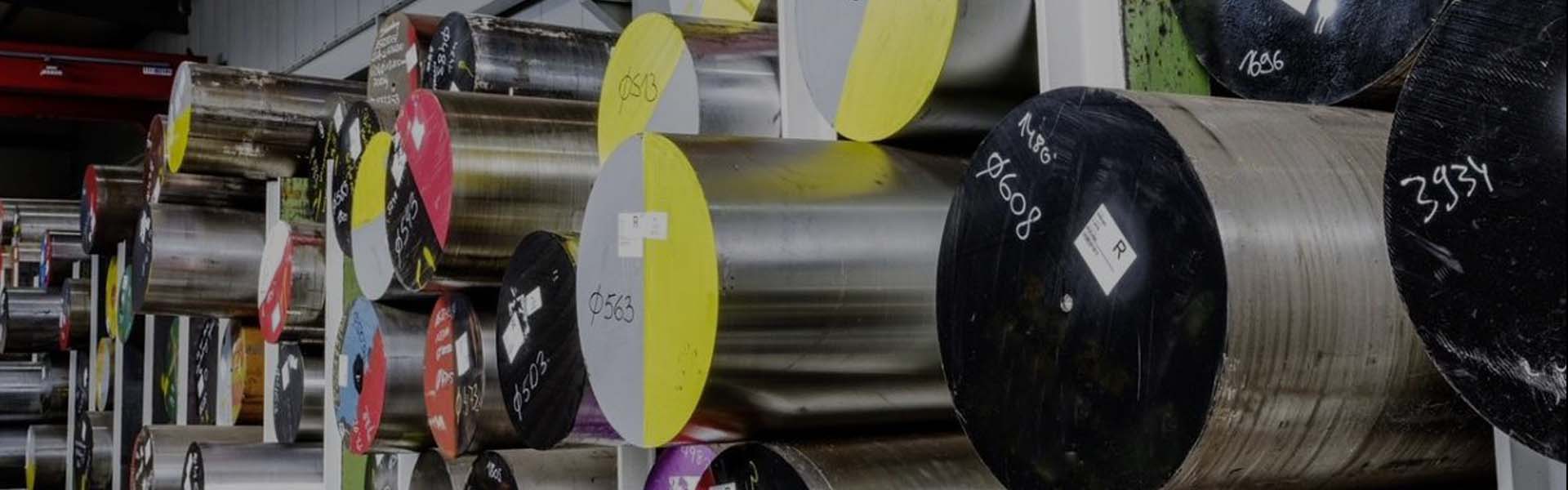
Toolman Special Steels is proud to produce and offer 1.2601 steel. It is a Ledeburitic Cr-steel and corresponds to material number 1.2601 (X165CrMoV12). This alloy possesses a very high compressive strength and is deep hardening. 1.2601 steel is designed for high-performance cutting tools. It offers superior toughness compared to D3 steel and can be nitrided to enhance surface hardness and wear resistance.
Steel Properties
-
Wear resistance
-
Compressive Strength
Chemical Composition
| C | Si | Mn | P | S | Cr | Mo | V | W |
|---|---|---|---|---|---|---|---|---|
| 1.60 | 0.35 | 0.30 | 0.03 | 0.03 | 11.50 | 0.60 | 0.30 | 0.50 |
Mechanical Properties
| Property | Value |
|---|---|
| Annealing Hardness (HBW) | 250 max |
| Tensile Strength | 1500-2000 MPa |
| Yield Strength | 1300-1800 MPa |
Physical Properties
| Property | Value |
|---|---|
| Density (g/cm³) | 7.70 |
Modulus of Elasticity
| Temperature (°C) | GPa |
|---|---|
| 20 | 210 |
Thermal Properties
| Temperature (℃) | Thermal Expansion Coefficient (10^-6/℃) |
|---|---|
| 20-100 | 10.5 |
Thermal Conductivity
| Temperature (℃) | Thermal Conductivity (W/m•K) |
|---|---|
| 20 | 20 |
HEAT TREATMENT AND PROCESSES
Heat treatment
| Process | Description | Temperature Range | Cooling Method | Resulting Hardness |
|---|---|---|---|---|
| Soft Annealing | Heating to 800-840°C followed by slow cooling in a furnace. This relieves internal stresses and produces a maximum Brinell hardness of 255. | 800-840°C | Slow furnace cooling | Maximum 255 Brinell |
| Stress Relieving | Heating to 650°C, holding for one hour, then air cooling. This process is done to relieve machining stresses and reduce distortion during heat treatment. | 650°C | Air cooling | - |
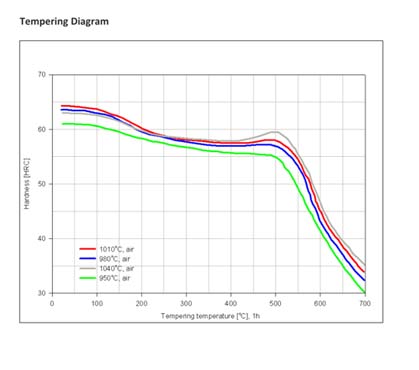
| Hardening | Heating to 980-1010°C followed by quenching in oil, air, or warm bath. This process increases hardness (63-65 HRC) by transforming the material's structure. | 980-1010°C | Oil, air, or warm bath quenching | 63-65 HRC |
| Tempering | Heating to 150-400°C. This process follows hardening and reduces brittleness, increasing toughness and ductility while maintaining some hardness | 150-400°C | - | - |
| Tempering °C | HRC |
|---|---|
| 100 | 64 |
| 200 | 62 |
| 300 | 60 |
| 400 | 58 |
Applications
-
Machine knife (for producers)
-
Rolling Cold Forming
-
Fine Blanking, Stamping, Blanking Standard Parts (Molds, Plates, Pins, Punches)
-
Components for Recycling Industry
-
Components for Recycling Industry
-
General Components for Mechanical Engineering
-
Cutting tools, stamping, woodworking, drawing, deep drawing and pressing tools, cold working rolls, measuring tools.
Quality Assurance
Our D2 M 1.2601 steel undergoes rigorous testing and quality control to meet international standards, ensuring consistent performance and reliability. Certificates and test reports are available upon request. Feel free to reach out to us for more information on our 1.2601 steel products or to discuss your specific requirements. We're dedicated to providing top-quality steel solutions that meet your needs and exceed your expectations.
Manufacturing Range
| Products | Diameter (mm) |
|---|---|
| Hot Rolled bar | 8 - 65 |
| Forged and Turned bars | 65.2 - 500 |
| Forged Square Bars | 50 - 500 |
Flats
| THICKNESS | WIDTH |
|---|---|
| 6.00 mm - 410.00 mm | 20.00 mm - 700.00 mm |
Frequently Asked Questions
We manufacture DIN 1.2601 / X165CrMoV12 as a ledeburitic chromium cold work tool steel with very high compressive strength and deep-hardening capability. It is designed for high-performance cutting and cold work applications where wear resistance is critical.
We position DIN 1.2601 where higher toughness than D3 is required. It also offers strong wear resistance and compressive strength and can be nitrided where additional surface hardness and wear resistance are needed.
We supply DIN 1.2601 for:
- Machine knives
- Cold-forming and rolling tools
- Fine blanking and stamping tools
- Moulds, plates, pins and punches
- Recycling-industry components
- Cutting and woodworking tools
- Drawing and deep-drawing tools
- Pressing tools
- Cold-working rolls
- Measuring tools
Our heat-treatment guidance includes:
- Soft annealing: 800–840°C
- Stress relieving: 650°C
- Hardening: 980–1010°C
- Hardness after hardening: 63–65 HRC
- Tempering: 150–400°C
Our tempering data shows approximately 64 HRC at 100°C, 62 HRC at 200°C, 60 HRC at 300°C and 58 HRC at 400°C.
Our listed composition includes:
- Carbon: 1.60%
- Chromium: 11.50%
- Molybdenum: 0.60%
- Tungsten: 0.50%
- Vanadium: 0.30%
- Silicon: 0.35%
- Manganese: 0.30%
Our manufacturing range includes:
- Hot-rolled bars: 8–65 mm
- Forged and turned bars: 65.2–500 mm
- Forged square bars: 50–500 mm
- Flats: 6–410 mm thickness
- Flat widths: 20–700 mm
Yes. We carry out testing and quality control on our DIN 1.2601 steel, and certificates and test reports are available on request.
