
How the Right H13 Steel Supplier Extends Tool Life
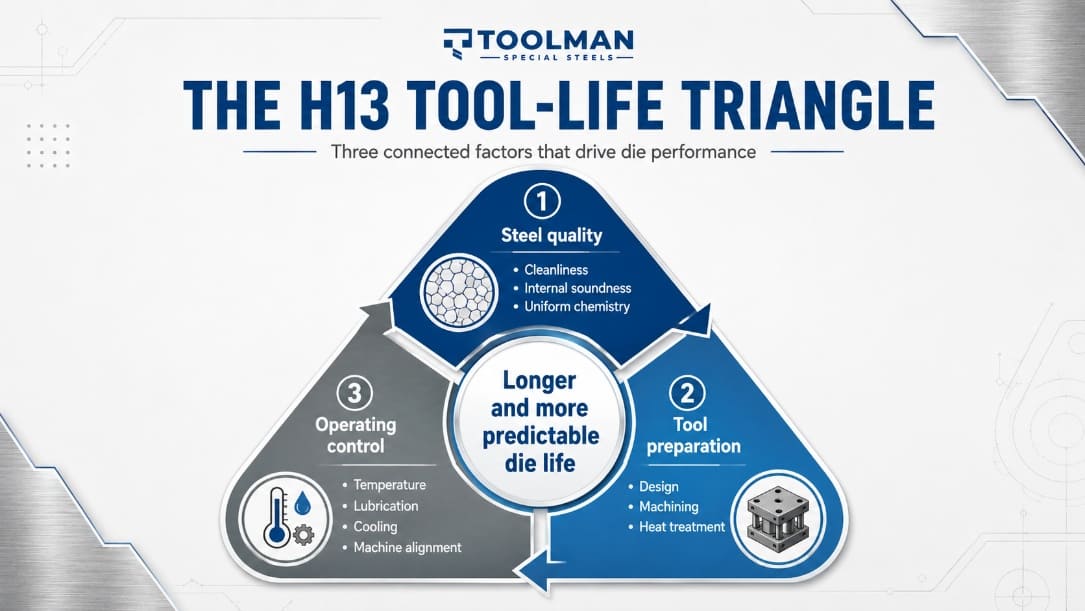
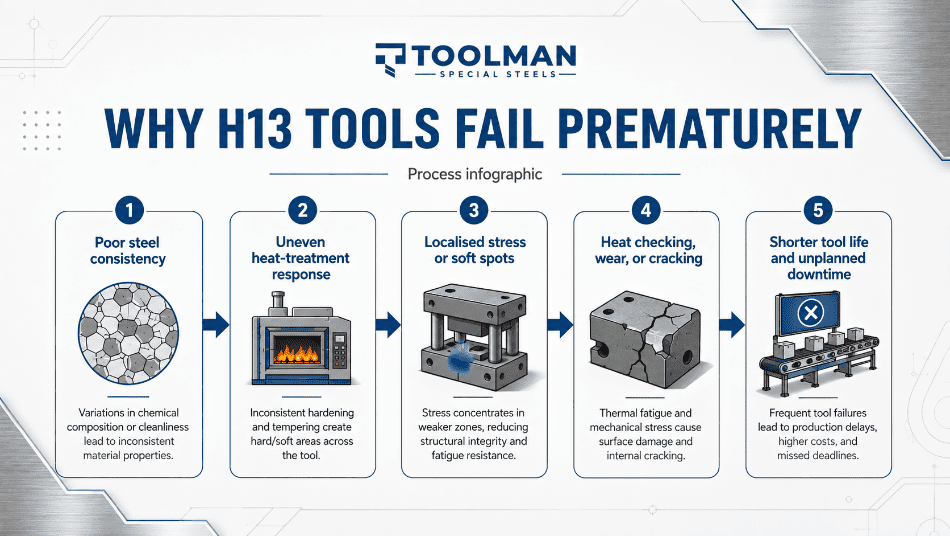
In hot-work tooling, failure rarely begins with one dramatic event. More often, it develops gradually through repeated heating and cooling, mechanical loading, surface wear, dimensional change and small thermal cracks that expand with every production cycle.
The steel grade matters, but the grade name alone does not guarantee performance.
Two tools may both be labelled H13 and still deliver noticeably different service lives. The difference can come from steel cleanliness, carbide distribution, heat-treatment control, internal soundness, dimensional allowance, supply condition and the manufacturer’s ability to maintain consistency from one batch to the next.
That is why selecting the right H13 steel manufacturer in India is not merely a sourcing decision. It is a tooling-performance decision.
For die casters, extrusion plants, forging companies, mould makers and tool rooms, reliable H13 steel can contribute to longer die life, fewer premature failures, more predictable maintenance and better production continuity.
What is H13 Tool Steel?
H13 is a chromium-molybdenum-vanadium hot-work tool steel developed for tooling exposed to elevated temperatures, repeated thermal cycling and substantial mechanical stress.
Its combination of toughness, hot strength, wear resistance and resistance to thermal fatigue makes it one of the most widely used grades for dies, inserts, punches, extrusion tooling and pressure die-casting components.
Toolman Special Steels identifies H13 as AISI H13, DIN 1.2344 and UNS T20813. It is a versatile chromium-molybdenum hot-work steel offering high toughness and resistance to thermal fatigue. The grade can provide an additional safety margin in tools exposed to hammer blows, deep recesses and sharp corners.
H13 at a Glance
|
Parameter |
Details |
|
Steel category |
Hot-work tool steel |
|
AISI designation |
H13 |
|
DIN designation |
1.2344 |
|
UNS designation |
T20813 |
|
Alloy family |
Chromium-molybdenum-vanadium steel |
|
Primary performance strengths |
Toughness, thermal stability, wear resistance, resistance to thermal fatigue |
|
Typical tooling environments |
Die casting, hot forging, extrusion, hot shearing, mould and die production |
Grade designations and Toolman-specific performance descriptions are based on Toolman Special Steels’ official H13 product information.
Why Tool Life Depends on More Than the H13 Grade Name
Specifying H13 is only the first step. Tool longevity depends on whether the delivered material possesses the metallurgical consistency required by the application.
A dependable H13 supplier should help control several variables.
1. Chemical consistency
The alloying elements in H13 work together to create its hot-work performance.
Chromium supports hardenability and resistance to softening. Molybdenum contributes to elevated-temperature strength and hardenability. Vanadium helps control grain structure and contributes to wear resistance through carbide formation.
If chemistry varies excessively within or between heats, the resulting response to heat treatment may also vary.
2. Internal soundness
Large dies, blocks and forged bars must be free from unacceptable internal discontinuities. Defects that are invisible at the surface can become crack-initiation points under cyclic loading.
For this reason, ultrasonic testing and traceable inspection become especially important in critical tooling.
3. Steel cleanliness
Non-metallic inclusions and macro-segregation can negatively affect fatigue behaviour, polishability, toughness and crack resistance.
Cleaner, more uniform steel is particularly valuable in:
- High-pressure aluminium die casting
- Large extrusion dies
- Deep cavities
- Highly polished mould components
- Tools exposed to severe thermal cycling
- Components with sharp transitions or complex geometry
4. Heat-treatment response
Even correctly specified H13 can underperform when the steel structure is inconsistent or when hardening and tempering are not properly controlled.
The material should respond uniformly so that the toolmaker can achieve the intended balance between hardness and toughness throughout the section.
5. Supply condition and machining allowance
Toolmakers require predictable machinability, adequate stock allowance, suitable annealed hardness and the correct product form. Excessive decarburisation, poor straightness, inadequate machining stock or inconsistent hardness can add cost before the tool even enters service.
How H13 Steel Extends Tooling Longevity
H13 does not extend life through one property alone. Its value comes from a balanced performance profile.
1. Resistance to Thermal Fatigue
Hot-work tools repeatedly contact heated metal, then cool between cycles. This repeated expansion and contraction creates thermal stress at the surface.
Over time, a network of fine cracks may develop. This is commonly known as heat checking or thermal fatigue cracking.
A properly manufactured and heat-treated H13 tool can resist the initiation and propagation of these cracks more effectively than a material lacking the necessary hot-work balance.
Toolman highlights thermal stability and resistance to thermal fatigue among the grade’s principal characteristics.
2. High Toughness
Hardness alone is not enough in tooling exposed to impact, pressure and uneven loading.
A die may need to withstand:
- Sudden mechanical loads
- Misalignment
- Hammer blows
- Stress concentration around corners
- Localised thermal shock
- Ejection loads
- Interrupted contact
H13 is valued because it can combine usable hardness with resistance to gross cracking.
Toolman specifically positions the grade for tools containing deep recesses and sharp corners, as well as applications involving hammer blows.
3. Resistance to Softening at Elevated Temperatures
A tool that loses hardness during operation may experience accelerated wear, deformation, edge rounding and dimensional instability.
H13 is designed to retain useful mechanical properties at elevated working temperatures. This thermal stability helps dies and inserts maintain geometry through repeated production cycles.
4. Wear Resistance
Tool surfaces may be exposed to abrasion, metal flow, friction, scale and repeated contact.
H13 offers wear resistance appropriate for many hot-work environments while retaining better toughness than extremely wear-resistant but more brittle grades.
This balance is important because maximising wear resistance at the expense of toughness can sometimes lead to catastrophic cracking rather than gradual, manageable wear.
5. Machinability in the Annealed Condition
Before hardening, H13 must often be milled, drilled, turned, ground or formed into complex tooling geometry.
Toolman lists good machinability in the annealed condition as one of the grade’s characteristics. Predictable machinability supports efficient tool production and reduces the risk of excessive machining time or uneven surface response.
Chemical Composition of Toolman H13 Steel
The following range is published on Toolman Special Steels’ official H13 page.
|
Element |
Toolman H13 Composition |
|
Carbon |
0.32–0.45% |
|
Silicon |
0.80–1.25% |
|
Manganese |
0.20–0.60% |
|
Phosphorus |
0.030% maximum |
|
Sulphur |
0.030% maximum |
|
Chromium |
4.75–5.50% |
|
Molybdenum |
1.10–1.75% |
|
Vanadium |
0.80–1.20% |
How the Alloying Elements Affect Performance
|
Alloying element |
Practical contribution to H13 tooling |
|
Carbon |
Supports hardness and carbide formation |
|
Chromium |
Improves hardenability and resistance to softening |
|
Molybdenum |
Supports hot strength and through-hardening response |
|
Vanadium |
Contributes to fine grain structure and wear resistance |
|
Silicon |
Supports temper resistance and hot-work performance |
|
Manganese |
Assists hardenability and steelmaking control |
The chemical range should not be viewed as an isolated specification. Melting, refining, forging, annealing, heat treatment and inspection determine how effectively that chemistry is converted into tooling performance.
Toolman H13 Mechanical-Property Data
|
Property |
Published value |
|
Annealed hardness |
235 HBW maximum |
|
Hardness after quenching |
52 HRC minimum |
|
Tensile strength |
1,450–1,950 MPa |
|
Yield strength |
1,200–1,550 MPa |
|
Elongation at break |
10–15% |
|
Impact toughness at 20°C |
20–30 J |
Values are reproduced from Toolman Special Steels’ official H13 product data. Final properties depend on section size, heat treatment, test orientation and supply condition.
These numbers are useful, but buyers should avoid selecting tooling steel on a single hardness value. A high hardness target may improve wear resistance while reducing toughness. The correct working hardness should be chosen according to the tool geometry, operating temperature, impact severity, failure history and production conditions.
Where H13 Steel is Commonly Used
H13 is used where tooling must operate under a combination of heat, pressure, mechanical stress and repeated cycling.
Toolman steel is commonly used to create dies, shear blades, bulldozer dies, pressure die-casting ejectors and nozzles, ejector pins, tool holders, shrink-fit chucks, hot cropping, billet shearing, circular shearing, inserts, plungers and metal-track pressure tools.
Typical H13 Tooling Applications
|
Industry or process |
Typical H13 components |
Main operating challenge |
|
Aluminium pressure die casting |
Die inserts, cores, ejector pins, nozzles |
Thermal fatigue, soldering, pressure and cracking |
|
Hot forging |
Forging dies, punches and inserts |
Impact, heat, wear and deformation |
|
Extrusion |
Dies, liners, mandrels and dummy blocks |
High pressure, elevated temperature and abrasion |
|
Plastic moulding |
Mould components and inserts |
Thermal cycling, surface finish and dimensional stability |
|
Hot shearing |
Shear blades and cropping tools |
Impact and hot abrasion |
|
Metal forming |
Punches and forming dies |
Mechanical load and edge wear |
|
Toolholding |
Tool holders and shrink-fit components |
Strength and dimensional reliability |
The Connection Between Supplier Quality and Common Tool Failures
The supplier cannot control every aspect of tool life. Tool design, heat treatment, machining practice, surface treatment, lubrication, process temperature and equipment alignment also matter.
However, inconsistent starting material can undermine even a well-designed and properly operated tool.
|
Tool failure |
Possible steel-related contributor |
Supplier capability that helps reduce risk |
|
Premature gross cracking |
Low toughness, inclusions, internal defects, poor structure |
Clean steelmaking, remelting, ultrasonic inspection |
|
Heat checking |
Inadequate thermal-fatigue resistance or unsuitable heat-treatment response |
Consistent chemistry and refined structure |
|
Chipping around corners |
Poor toughness or stress concentration |
Uniform metallurgy and technical grade guidance |
|
Early surface wear |
Insufficient hardness or poor carbide distribution |
Controlled composition and heat-treatment consistency |
|
Distortion during hardening |
Uneven structure, residual stress, inconsistent section |
Proper forging, annealing and stock preparation |
|
Soft spots |
Non-uniform hardening response |
Metallurgical control and verified material condition |
|
Unpredictable batch life |
Heat-to-heat variation |
Traceability, inspection and consistent process control |
This is why a low initial steel price does not always produce the lowest tooling cost. A die that requires early repair, unexpected polishing, re-machining, or premature replacement may cost far more through production loss than the saving achieved during raw-material procurement.
Conventional H13 vs H13 ESR
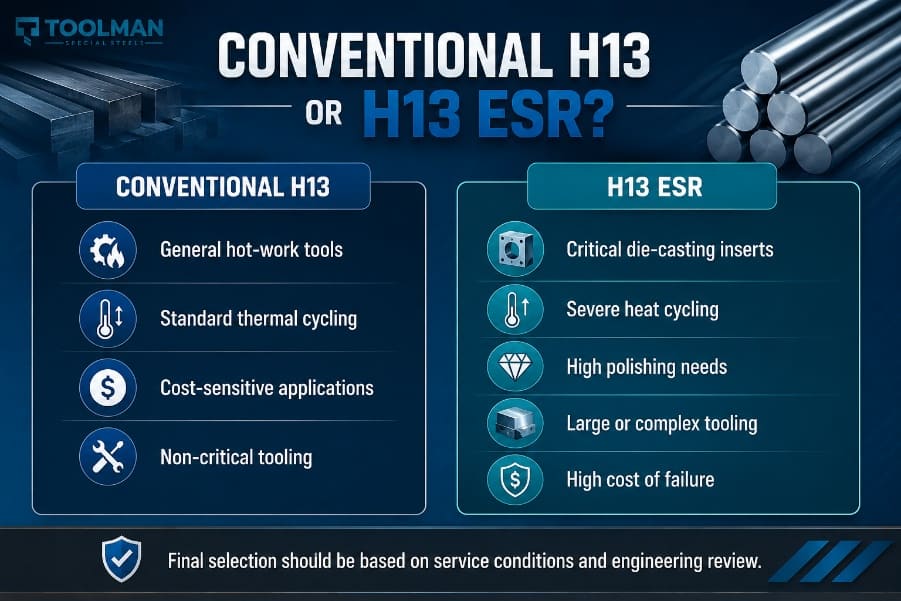
For standard tooling conditions, conventionally produced H13 may be suitable. More demanding applications may benefit from Electro-Slag Remelted H13, commonly identified as H13 ESR.
At Toolman, we manufacture H13 ESR, a premium-grade tool steel produced using the Electro Slag Remelting (ESR) process. This refining process enhances the steel's micro-cleanliness, produces an extra-fine grain structure, improves material uniformity, reduces macro-segregation and promotes a fine, evenly distributed carbide structure.
These characteristics make our H13 ESR particularly well suited for demanding applications such as aluminium pressure die casting and components that operate under high temperatures and high mechanical loads. For consistent quality and reliability, every bar is subjected to 100% ultrasonic inspection in accordance with applicable nondestructive testing standards.
H13 and H13 ESR: Practical Comparison
|
Selection factor |
Conventional H13 |
H13 ESR |
|
General hot-work tooling |
Often suitable |
Suitable |
|
Metallurgical cleanliness |
Standard controlled quality |
Higher refinement and cleanliness |
|
Structural uniformity |
Dependent on conventional processing |
Improved through remelting |
|
Large or critical die-casting inserts |
May be considered after engineering review |
Frequently preferred |
|
High polishing requirements |
Application dependent |
Better suited where enhanced cleanliness is important |
|
Severe thermal cycling |
Suitable in many cases |
Often selected for more demanding duty |
|
Procurement cost |
Generally lower |
Generally higher due to additional remelting |
|
Potential lifecycle value |
Strong for standard applications |
Can be higher in critical tooling where failures are expensive |
The correct choice should be based on failure consequences, die size, cavity complexity, expected shot count, surface requirements and operating severity – not simply on the assumption that the most refined material is necessary for every tool.
Heat Treatment: Where H13 Performance is Won or Lost
The supplier provides the steel, but heat treatment converts the steel into a working tool.
Incorrect heat treatment can produce:
- Low hardness
- Excessive brittleness
- Retained austenite
- Distortion
- Decarburisation
- Uneven hardness
- Poor thermal-fatigue resistance
- Premature cracking
In our published H13 technical guide, we illustrate the steel's tempering response, showing hardness increasing from approximately 54 HRC at 100°C to a secondary-hardness peak of around 56 HRC at 500°C before gradually decreasing as the tempering temperature rises further. We also discuss martempering, recommending the use of a salt bath or fluidised bed at 450–550°C, or alternatively at 180–220°C, followed by controlled cooling to achieve the desired microstructure and properties.
Published Toolman H13 Tempering Response
|
Tempering temperature |
Approximate hardness |
|
100°C |
54 HRC |
|
210°C |
53 HRC |
|
300°C |
53 HRC |
|
400°C |
55 HRC |
|
500°C |
56 HRC |
|
550°C |
54 HRC |
|
600°C |
51 HRC |
|
650°C |
43 HRC |
|
700°C |
34 HRC |
This is Toolman’s published tempering data. It should be treated as technical guidance rather than a substitute for a tool-specific heat-treatment procedure.
Practical Heat-Treatment Considerations
A qualified heat-treatment provider should consider:
- Tool section size
- Geometry and wall-thickness variation
- Sharp corners and deep cavities
- Preheating stages
- Austenitising temperature and holding time
- Quenching medium and cooling rate
- Tempering temperature
- Number of tempering cycles
- Final hardness target
- Distortion allowance
- Surface protection during heating
- Need for stress relieving after rough machining
For critical dies, communication between the steel manufacturer, toolmaker, heat treater and end user can be more valuable than selecting the grade in isolation.
Toolman’s H13 Manufacturing Range
Toolman publishes H13 in hot-rolled, forged-and-turned, forged-square and flat forms.
Bars and Squares
|
Product |
Manufacturing range |
|
Hot-rolled bars |
8–65 mm diameter |
|
Forged and turned bars |
65.2–500 mm diameter |
|
Forged square bars |
50–500 mm |
Flats
|
Thickness |
Width |
|
6–410 mm |
20–700 mm |
This range allows buyers to source material for small tooling components as well as larger dies, blocks, inserts and extrusion tooling. Final availability, tolerances, machining allowance, condition and custom-size feasibility should be confirmed at the enquiry stage.
What to Ask an H13 Steel Manufacturer Before Ordering
A technically complete purchase enquiry reduces misunderstandings and improves the chance of receiving material suited to the intended tool.
H13 Procurement Checklist
|
Question |
Why it matters |
|
Is the material AISI H13/DIN 1.2344? |
Confirms the requested grade designation |
|
Is conventional or ESR material required? |
Aligns steel cleanliness with application severity |
|
What is the exact product form and size? |
Determines suitable manufacturing route and availability |
|
What is the delivery condition? |
Affects machinability and downstream processing |
|
What annealed hardness is supplied? |
Helps plan machining operations |
|
Is ultrasonic testing available? |
Important for internal soundness, particularly in large sections |
|
Can a material test certificate be supplied? |
Supports chemical and batch traceability |
|
What machining allowance is included? |
Prevents undersized conditions after cleanup |
|
Is custom cutting or machining available? |
May reduce tool-room preparation time |
|
What is the intended final hardness? |
Helps connect steel selection with heat-treatment planning |
|
What is the end application? |
Allows the supplier to advise on grade and process suitability |
|
Is the tool exposed to severe thermal cycling? |
Helps determine whether ESR or another grade should be evaluated |
How to Choose the Right H13 Steel Manufacturer in India
The best supplier is not necessarily the one offering the widest catalogue or lowest quotation. It is the one capable of delivering repeatable material aligned with the tool’s service conditions.
1. Review the Manufacturer’s Melting and Refining Capabilities
At Toolman, our integrated manufacturing infrastructure includes melting, precision rolling, hot and open-die forging, ESR processing, bar peeling, finishing facilities and advanced metallurgical laboratories.
For H13, relevant capabilities may include:
- Controlled melting
- Ladle refining
- Vacuum degassing
- ESR processing
- Forging and rolling
- Annealing
- Machining and bar finishing
- Metallurgical inspection
2. Verify Testing and Traceability
Ask whether the manufacturer provides:
- Material test certificates
- Heat numbers
- Chemical-analysis reports
- Hardness verification
- Ultrasonic-testing reports
- Metallurgical inspection
- Dimensional reports
- Supply-condition records
Every Toolman H13 bar undergoes rigorous quality control, including ultrasonic testing, hardness profiling and metallurgical inspection. Certificates and test reports are available on request.
3. Confirm Experience with the Actual Application
A manufacturer familiar with pressure die casting may understand different failure risks from one supplying general-purpose hot-work bars.
Provide information about:
- Workpiece material
- Operating temperature
- Die or tool dimensions
- Expected production volume
- Cooling method
- Previous failure mode
- Surface-treatment requirements
- Required polishing level
- Heat-treatment route
- Desired working hardness
This allows the discussion to move beyond “Do you supply H13?” to “Which H13 condition is appropriate for this tool?”
4. Assess Dimensional and Supply Flexibility
The required steel may be needed as:
- Round bar
- Square bar
- Flat
- Block
- Rough-machined stock
- Turned bar
- Custom-cut piece
- ESR material
Toolman supplies H13 in hot-rolled, forged-and-turned, forged-square and flat forms, with bars, plates, sheets and custom-cut sizes available to meet diverse application requirements.
5. Evaluate Export and Documentation Support
For international buyers, metallurgy is only one part of the transaction. Packaging, marking, documentation and logistics affect whether material arrives in usable condition and on schedule.
We supply customers across global markets, including the USA, Europe, Japan, China and Turkey, with export-ready packaging, documentation, logistics support, custom sizes and technical guidance.
Related Hot-Work Steel Grades
H13 is a highly versatile hot-work tool steel, but it may not be the ideal choice for every application. At Toolman, we offer a range of hot-work steels, including:
H11, H12, H10, H21, DIN 1.2367 and DIN 1.2714, to meet different performance requirements and operating conditions.
H13 and Related Toolman Grades
|
Grade |
General selection context |
When it may be considered |
|
H13 / DIN 1.2344 |
Balanced hot-work performance |
Die casting, forging, extrusion, mould and die applications |
|
H11 / DIN 1.2343 |
High toughness and thermal-shock resistance |
Impact-heavy hot tooling and applications requiring greater toughness |
|
H12 / DIN 1.2606 |
Hot-work steel with excellent impact toughness |
Thermal shock, gross-cracking resistance and water-cooled service |
|
H10 / DIN 1.2365 |
Hot-work tool steel for elevated-temperature applications |
Selected hot-forming, extrusion and die applications |
|
H21 / DIN 1.2581 |
Tungsten-alloyed hot-work grade |
Applications prioritising hot hardness and wear resistance |
|
DIN 1.2367 |
Deep-hardening hot-work die steel |
Large or demanding dies requiring high hot strength |
|
DIN 1.2714 |
Tough die-block steel |
Large forging dies and impact-loaded tooling |
The final grade choice should be based on the dominant failure mechanism. A tool failing through abrasion may require a different balance from one failing through thermal shock or gross cracking.
Why Manufacturers Work with Toolman Special Steels
Established in 1957, Toolman Special Steels has grown into a global manufacturer, supplier and exporter of high-speed steels, hot-work steels, cold-work steels, die-block steels, PM steels and other speciality steel grades. With an annual steel production capacity of over 12,000 tons and a portfolio of more than 50 grades, we serve customers across international markets.
For H13 buyers, Toolman offers:
- AISI H13/DIN 1.2344 steel
- Conventional and ESR options
- Hot-rolled bars
- Forged and turned bars
- Forged square bars
- Wide flats
- Testing and material documentation
- Technical support for grade selection
- Custom-size and export support
Our integrated manufacturing infrastructure includes melting, forging, rolling, heat-treatment, machining, remelting and laboratory capabilities.
Closing Note
Long tool life does not begin when the die enters the machine. It begins when the steel is selected.
A correctly manufactured H13 grade gives toolmakers a dependable foundation for machining, heat treatment, finishing and production. A poorly matched or inconsistent material can introduce risk at every stage, even when the tool design and operating process appear correct.
When evaluating an H13 steel manufacturer in India, buyers should look beyond the nominal grade and compare steelmaking capability, remelting options, inspection, manufacturing range, technical support, traceability and batch consistency.
Toolman Special Steels supplies AISI H13/DIN 1.2344 in multiple product forms and manufacturing conditions, including refined ESR material for critical applications. With integrated capabilities covering melting, forging, rolling, remelting, machining, testing and export support, we help tooling manufacturers achieve consistent quality with reliable long-term performance.
Looking for H13 steel for die casting, forging, extrusion, hot shearing, or mould and die production?
Contact Toolman Special Steels with your dimensions, supply condition, application and testing requirements to identify the appropriate H13 option for your tooling programme.
Frequently Asked Questions
1. What is the equivalent grade of H13 steel?
H13 is commonly designated as AISI H13, DIN 1.2344 and UNS T20813.
2. Why is H13 widely used for die-casting dies?
H13 combines thermal stability, toughness, wear resistance and resistance to thermal fatigue. These properties help tooling withstand the repeated heating, cooling, pressure and mechanical loading encountered in pressure die casting.
3. Is H13 ESR better than conventional H13?
H13 ESR offers enhanced cleanliness and structural uniformity because the material undergoes an additional remelting process. Toolman recommends its ESR grade for aluminium pressure die casting and other components exposed to high working temperatures and high pressure. Conventional H13 may still be appropriate for many standard applications.
4. What is the annealed hardness of Toolman H13?
Toolman lists a maximum annealed hardness of 235 HBW for its H13 steel.
5. What hardness can H13 achieve after heat treatment?
A minimum hardness of 52 HRC after quenching. The tempering curve shows that hardness varies with tempering temperature and may reach approximately 56 HRC near 500°C under the stated conditions. The final target should be selected according to the application.
6. What sizes of H13 does Toolman manufacture?
Toolman offers H13 hot-rolled bars from 8 to 65 mm diameter, forged and turned bars from 65.2 to 500 mm, forged square bars from 50 to 500 mm and flats from 6 to 410 mm thick and 20 to 700 mm wide.
7. Can H13 be used for cold-work tools?
H13 is primarily a hot-work steel. However, it has also been used in cold-work applications where additional toughness is required, and some wear resistance can be sacrificed.
8. What information should be shared when requesting an H13 quotation?
A complete enquiry should include the grade, conventional or ESR requirement, dimensions, quantity, product form, supply condition, testing requirements, final application, intended hardness, machining allowance and required documentation.
9. How does the steel supplier affect die life?
The supplier influences chemical consistency, metallurgical cleanliness, internal soundness, structure, annealed condition, dimensional accuracy, traceability and heat-to-heat repeatability. These factors affect how the steel machines, heat treats and performs in service.
10. Is H13 always the best grade for hot-work tooling?
No. H13 is a balanced and versatile option, but H11, H12, H21, DIN 1.2367, or DIN 1.2714 may be more appropriate where thermal shock, impact toughness, hot hardness, die size, or wear requirements dominate.
Ready to upgrade? Contact our team today for expert guidance and support.
Contact