
A Practical Guide to Sourcing Reliable H11 Hot-Work Steel
Hot-work tooling is expected to perform under conditions that would quickly damage ordinary steels. Forging dies, extrusion tools, punches, mandrels and die-casting components repeatedly face high temperatures, mechanical pressure, rapid cooling and thermal shock.
In these environments, selecting H11 is only the beginning. You must also consider metallurgical consistency, supply condition, heat-treatment response, internal soundness, dimensions, testing and export documentation.
When you evaluate H11 steel exporters in India, the lowest quotation may not represent the lowest operating cost. Reliable material can help you reduce premature cracking, unplanned tool replacement, machining difficulties and variation between production batches.
At Toolman Special Steels, we manufacture and supply H11 for customers who need a dependable balance of toughness, hot strength, thermal-fatigue resistance and dimensional stability.
What Is H11 Hot-Work Tool Steel?
H11, also designated as DIN 1.2343 and X37CrMoV5-1, belongs to the family of 5% chromium hot-work tool steels.
It is engineered for tools exposed to repeated heating and cooling cycles. Instead of pursuing maximum hardness or wear resistance alone, H11 provides a controlled balance of:
- High toughness
- Resistance to thermal shock
- Good hot tensile strength
- Deep-hardening response
- Resistance to cracking and softening
- Useful wear resistance
- Good thermal conductivity
Compared with H13, H11 generally contains slightly less carbon and vanadium. This contributes to higher toughness and better resistance to cracking under severe thermal cycling or intermittent water cooling.
H11 at a Glance
|
Parameter |
Details |
|
Steel category |
Hot-work tool steel |
|
AISI designation |
H11 |
|
DIN designation |
1.2343 |
|
Common name |
X37CrMoV5-1 |
|
Alloy system |
Chromium-molybdenum-vanadium |
|
Primary advantage |
Toughness under heat and thermal cycling |
|
Typical applications |
Forging, extrusion, die casting, hot punching and hot shearing |
Why H11 is Used in Demanding Hot-Work Applications
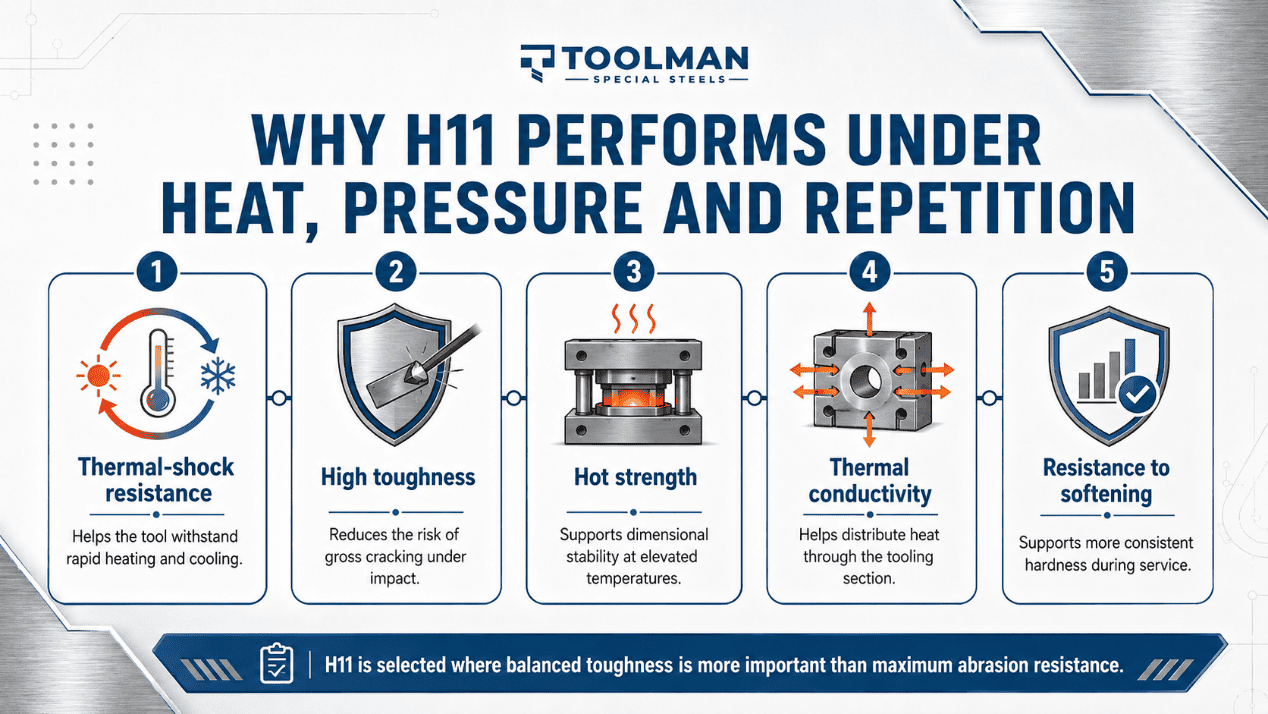
Hot-work tools rarely operate under one simple load. A forging die may experience impact, heat, pressure, abrasion and rapid surface cooling within the same production cycle.
H11 performs well because it can absorb these combined stresses without becoming excessively brittle.
Resistance to Thermal Shock
Rapid temperature changes cause the surface and core of a tool to expand and contract at different rates. This creates internal stress and may eventually produce heat checking or larger cracks.
H11 is especially valuable where thermal shock and crack resistance matter more than achieving the highest possible wear resistance. This makes it relevant for large die blocks, forging tools, hot punches, extrusion components and water-cooled tooling.
High Toughness
Hard steel is not automatically durable steel. If a hot-work tool is too brittle, impact loading or a local stress concentration may cause chipping or complete fracture.
H11 offers a strong combination of hardness and toughness, allowing you to use it in tools subjected to impact, pressure, complex geometry, or interrupted loading.
Strength at Elevated Temperatures
H11 maintains useful strength at high operating temperatures. This helps tools resist deformation, edge collapse and dimensional instability during repeated production cycles. Toolman also identifies resistance to softening and good hot tensile strength among the grade’s principal characteristics.
Chemical Composition of Toolman H11
The following composition range is published for our H11/DIN 1.2343 steel.
|
Element |
Minimum |
Maximum |
|
Carbon |
0.33% |
0.43% |
|
Silicon |
0.80% |
1.25% |
|
Manganese |
0.20% |
0.60% |
|
Chromium |
4.75% |
5.50% |
|
Molybdenum |
1.10% |
1.60% |
|
Vanadium |
0.30% |
0.60% |
|
Sulphur |
— |
0.03% |
|
Phosphorus |
— |
0.03% |
|
Nickel + copper |
— |
0.75% |
Chromium improves hardenability and supports resistance to heat and softening. Molybdenum contributes to hot strength, while vanadium supports wear resistance and microstructural stability. The comparatively controlled carbon and vanadium levels help H11 maintain the toughness required in thermally demanding tooling.
Mechanical and Thermal Properties
|
Property |
Toolman’s published value |
|
Annealed hardness |
235 HBW maximum |
|
Hardness after quenching |
53 HRC minimum |
|
Tensile strength |
1,792 MPa |
|
Yield strength |
1,482 MPa |
|
Elongation |
8% |
|
Density |
7.8 g/cm³ |
|
Modulus of elasticity |
215 GPa |
Actual properties may vary according to section size, test direction, heat-treatment process and final supply condition.
Common Applications of H11 Steel
You should consider H11 when your tool must withstand temperature fluctuations, impact and mechanical pressure.
|
Industry or process |
Typical H11 components |
|
Hot forging |
Forging dies, hammer tools and hot gripper dies |
|
Extrusion |
Dies, mandrels, liners and bridge-type tools |
|
Pressure die casting |
Dies, ejector pins and die holders |
|
Hot shearing |
Shear blades and cropping tools |
|
Hot punching |
Punches, holders and forming tools |
|
Plastic processing |
Injection mould tooling and extrusion dies |
|
General tooling |
Tool holders, shrink-fit chucks and high-load fixtures |
We also list H11 for knives, moulds, punches, aircraft landing-gear tooling and tools used for the hot forging of light metals.
H11, H13 or DIN 1.2367?
The right hot-work grade depends on the dominant source of failure.
|
Grade |
Main strength |
Typical selection context |
|
H11 / DIN 1.2343 |
Toughness and thermal-shock resistance |
Forging, extrusion and impact-loaded hot-work tools |
|
H13 / DIN 1.2344 |
Balanced wear and thermal-fatigue resistance |
Die casting and general hot-work dies |
|
DIN 1.2367 |
Deep hardenability and high-temperature strength |
Heavy-section dies and highly demanding hot-work tooling |
H11 is often preferred where your current tool fails through gross cracking or thermal shock. H13 may be more suitable where wear resistance and die-casting performance are the main priorities. DIN 1.2367 can be evaluated where large sections require deeper hardenability and greater high-temperature strength.
Heat Treatment of H11 Steel
Heat treatment determines whether H11 develops the intended combination of hardness, toughness and dimensional stability.
|
Process |
Temperature |
Duration |
Cooling |
|
Soft annealing |
800–860°C |
2–5 hours |
Furnace |
|
Stress-relief annealing |
600–650°C |
Minimum 4 hours |
Furnace |
|
Hardening |
1,020–1,060°C |
According to section and process |
Oil, air or warm bath |
|
Tempering |
530–700°C |
Minimum 2 hours |
Still air |
Double tempering is generally recommended to improve dimensional stability and thermal-fatigue resistance. The exact cycle must be adapted to the size, geometry, hardness target and available heat-treatment equipment.
Tempering Response
|
Tempering temperature |
Approximate hardness |
|
100°C |
52 HRC |
|
300°C |
52 HRC |
|
500°C |
54 HRC |
|
550°C |
53 HRC |
|
600°C |
48 HRC |
|
650°C |
37 HRC |
|
700°C |
31 HRC |
This response shows why tempering temperature must be selected according to the required balance between hardness and toughness.
Toolman H11 Manufacturing Range
We manufacture H11 in several forms for small components, large dies and custom hot-work tooling.
|
Product form |
Manufacturing range |
|
Hot-rolled round bars |
8–65 mm diameter |
|
Forged and turned bars |
65.2–500 mm diameter |
|
Forged square bars |
50–500 mm |
|
Flats |
6–410 mm thickness |
|
Flat widths |
20–700 mm |
We can support requirements for bars, flats, plates, custom die blocks, annealed material and heat-treated conditions, subject to the final specification and order review.
What You Should Check Before Sourcing H11
A complete enquiry helps us supply the correct material and condition.
|
Information to provide |
Why it matters |
|
Required designation |
Confirms H11/DIN 1.2343 |
|
Dimensions and quantity |
Determines manufacturing and stock route |
|
Product form |
Bar, flat, plate or die block |
|
Supply condition |
Affects machining and heat treatment |
|
Final application |
Helps confirm grade suitability |
|
Previous failure mode |
Identifies whether cracking, wear or deformation dominates |
|
Required testing |
May include ultrasonic and hardness testing |
|
Final hardness target |
Supports heat-treatment planning |
|
Documentation |
Important for traceability and exports |
|
Machining allowance |
Prevents undersize material after finishing |
You should also verify steel cleanliness, internal soundness, annealed hardness, dimensional tolerances, heat-number traceability and the availability of inspection certificates.
Why Source H11 From Toolman?
We have manufactured tool-steel grades since establishing our own forging operations in 2000 and our production history includes H11 and H13 flats. Today, our infrastructure covers melting, casting, remelting, forging, rolling, heat treatment, machining and metallurgical inspection.
For H11 buyers, we offer:
- Multiple product forms and size ranges
- Annealed and heat-treated supply options
- Ultrasonic testing and hardness profiling
- Material certificates and test reports
- Technical support for application review
- Export-ready documentation and logistics support
We supply special steels to customers in the USA, Japan, China, Europe, Turkey and other international markets.
Related Hot Work Tool Steel Grades
Along with H11 / DIN 1.2343 / AISI H11, Toolman Special Steels manufactures and supplies an extensive range of hot work tool steels for demanding forging, extrusion, die-casting, forming and high-temperature tooling applications.
Explore related grades:
- H13 / DIN 1.2344 / AISI H13
- H12 / DIN 1.2606 / AISI H12 –
- H10 / DIN 1.2365 / AISI H10
- H21 / DIN 1.2581 / AISI H21
- DB6 / DIN 1.2714
- DIN 1.2367 Hot Work Tool Steel
Toolman’s wider hot work steel portfolio also includes D2 / DIN 1.2601 and other special grades supplied for diverse tooling and industrial requirements.
Need H11 Tool Steel for Your Application?
Discuss your required grade, dimensions, product form, heat-treatment condition, testing requirements and destination with the Toolman Special Steels team. Our technical experts can help review your application and provide an export-ready supply proposal.
Request a Quote Today
- Download the specs sheet
Call: +91 98155 25326 or +91 95018 53532
Email: indiatoolman@gmail.com
Closing Note
Sourcing H11 is not simply a matter of matching the words “H11” or “DIN 1.2343” on a quotation. The material must arrive with the right chemistry, structure, dimensions, supply condition, inspection and documentation.
At Toolman Special Steels, we help you evaluate H11 according to the operating conditions of your tooling. Whether you require forged bars, flats, die blocks, annealed stock, or export-ready material, we can support your requirement with technical guidance and a documented manufacturing route.
The right H11 steel gives you more than hot strength. It gives you a reliable foundation for machining, heat treatment, stable production and longer tooling life.
Frequently Asked Questions
Is H11 the same as DIN 1.2343?
Yes. H11 is commonly designated as AISI H11, DIN 1.2343 and X37CrMoV5-1.
Is H11 better than H13?
Neither grade is universally better. H11 generally offers greater toughness and thermal-shock resistance, while H13 is often selected for a stronger balance of wear resistance and thermal-fatigue performance.
What hardness can H11 achieve?
We publish a minimum hardness of 53 HRC after quenching. Final working hardness depends on the tempering cycle and application requirements.
Is H11 suitable for forging dies?
Yes. Its toughness, hot strength and resistance to thermal fatigue make it suitable for forging dies, hammer tools, punches and related hot-work components.
What information should you send with an H11 enquiry?
Send the grade, dimensions, quantity, product form, supply condition, application, hardness target, testing requirements and required documentation.
Ready to upgrade? Contact our team today for expert guidance and support.
Contact