How to Choose the Right Steel Grade for High-Performance Knives
A knife’s performance depends on far more than how sharp its edge feels when it leaves the factory. The blade must retain that edge, resist chipping, withstand impact, respond predictably to heat treatment and remain practical to grind and maintain.
This is why there is no single “best” knife steel. A grade that performs exceptionally in a precision slitting blade may be unsuitable for a wood-chipping knife exposed to repeated shock. Similarly, a grade selected for maximum abrasion resistance may be unnecessarily difficult to machine and sharpen in a less demanding application.
When you work with an experienced knife-making steel manufacturer in India, the objective should not be to select the hardest available material. It should be to identify the right balance of hardness, toughness, wear resistance, dimensional stability and manufacturability for your blade.
Begin With the Knife’s Working Conditions
Before choosing a grade, define how the knife will actually operate.
Ask:
- What material will the blade cut?
- Is the cutting action continuous, intermittent, or impact-heavy?
- Is edge retention more important than resistance to chipping?
- Will the knife operate at elevated temperatures?
- How frequently can it be resharpened?
- Does the blade have a thin, delicate edge or a heavy cross-section?
- Is dimensional stability during heat treatment critical?
These questions help separate general-purpose knife steels from grades intended for severe abrasion, impact, high-speed cutting, or hot service.
The Five Properties That Matter Most
1. Hardness
Hardness helps an edge resist deformation. However, simply increasing hardness can make a blade more vulnerable to cracking or chipping. The appropriate hardness depends on the knife design, cutting material and impact level.
2. Wear Resistance
Wear resistance determines how long the cutting edge can operate before it becomes rounded or dull. Grades containing hard alloy carbides are often selected for abrasive materials and long production runs.
3. Toughness
Toughness is essential when a blade experiences shock, vibration, knots, inconsistent feed, or accidental overload. A tough steel can absorb more energy before cracking.
4. Dimensional Stability
Industrial knives must often maintain tight tolerances after hardening and tempering. Excessive distortion can increase grinding costs or make the blade unusable.
5. Grindability
Every knife eventually requires grinding or sharpening. Extremely wear-resistant grades can provide long edge life but may also require more time, specialised abrasives and greater grinding control.
Comparing Toolman Grades for Knife Applications
We manufacture several cold-work and high-speed steel grades that can be considered for different blade requirements. The correct selection depends on the dominant failure mechanism rather than the knife’s name alone.
|
Grade |
Principal strength |
Suitable selection context |
|
A8 Modified |
Strong toughness and wear-resistance balance |
Wood-chipping knives, veneer knives and industrial knives |
|
D2 / DIN 1.2379 |
High wear resistance and dimensional stability |
Slitting blades, industrial knives and precision cutting tools |
|
D2 / DIN 1.2601 |
High compressive strength and cutting performance |
Machine knives and severe cold-cutting applications |
|
D3 / DIN 1.2080 |
Very high abrasion resistance |
Blades exposed to severe wear and comparatively limited impact |
|
A2 / DIN 1.2363 |
Balanced toughness and wear resistance |
Cutting tools and impact-sensitive cold-work blades |
|
O1 / DIN 1.2510 |
Edge retention, machinability and fine grain structure |
General cutting tools and knives requiring straightforward processing |
|
S1 / DIN 1.2550 |
Very high impact resistance and toughness |
Shock-loaded cutting and woodworking tools |
|
M2 / DIN 1.3343 |
Hot hardness and high-speed cutting capability |
Knives operating under high cutting speeds or elevated edge temperatures |
These classifications are based on the properties and applications published for our official grade range.
A8 Modified: A Practical Industrial Knife Steel
A8 Modified is especially relevant where your blade needs greater toughness than a conventional high-carbon, high-chromium grade but still requires meaningful wear resistance.
We identify A8 Modified for applications including industrial knives, wood-chipping knives, veneer knives, cutting tools and extrusion tooling. Compared with D2, it has higher toughness, making it useful where chipping and impact failure are major concerns.
Toolman A8 Modified Composition
|
Element |
Published value |
|
Carbon |
0.52% |
|
Silicon |
0.95% |
|
Manganese |
0.40% |
|
Chromium |
8.00% |
|
Molybdenum |
1.40% |
|
Vanadium |
0.45% |
The moderate carbon level and chromium-molybdenum-vanadium alloy system provide a useful balance between surface strength, hardenability, cutting ability, temper resistance and toughness.
D2 and DIN 1.2601 for Wear-Intensive Knives
D2, also known as DIN 1.2379, is a high-carbon, high-chromium cold-work steel known for wear resistance, edge retention and dimensional stability. These characteristics have made it widely relevant to industrial knife manufacturing, stamping and sheet-metal processing.
For more demanding machine-knife applications, DIN 1.2601 can also be considered. We describe this grade as a high-performance cutting steel with high compressive strength, deep-hardening capability and better toughness than D3. Its listed applications specifically include machine knives, woodworking tools and cutting components.
D2 1.2601 Key Data
|
Property |
Value |
|
Annealed hardness |
250 HBW maximum |
|
Tensile strength |
1,500–2,000 MPa |
|
Yield strength |
1,300–1,800 MPa |
|
Hardening range |
980–1,010°C |
|
Hardness after hardening |
63–65 HRC |
|
Tempering range |
150–400°C |
This grade can deliver excellent cutting performance, but its high alloy and carbide content means that heat treatment and grinding must be controlled carefully.
When Toughness Matters More Than Maximum Wear Resistance
Not every knife fails because it becomes dull. Some fail through edge chipping, cracking, or complete fracture.
For shock-loaded blades, A2 or S1 may provide a better performance balance than a higher-wear grade.
A2 combines wear resistance with comparatively high toughness and dimensional stability during air hardening. It is useful where you need more resistance to impact than D2 while maintaining good cutting performance.
S1 is a shock-resisting steel with very high toughness and hardenability. We list it for plate-cutting and woodworking tools, making it relevant where repeated impact is more severe than abrasive wear.
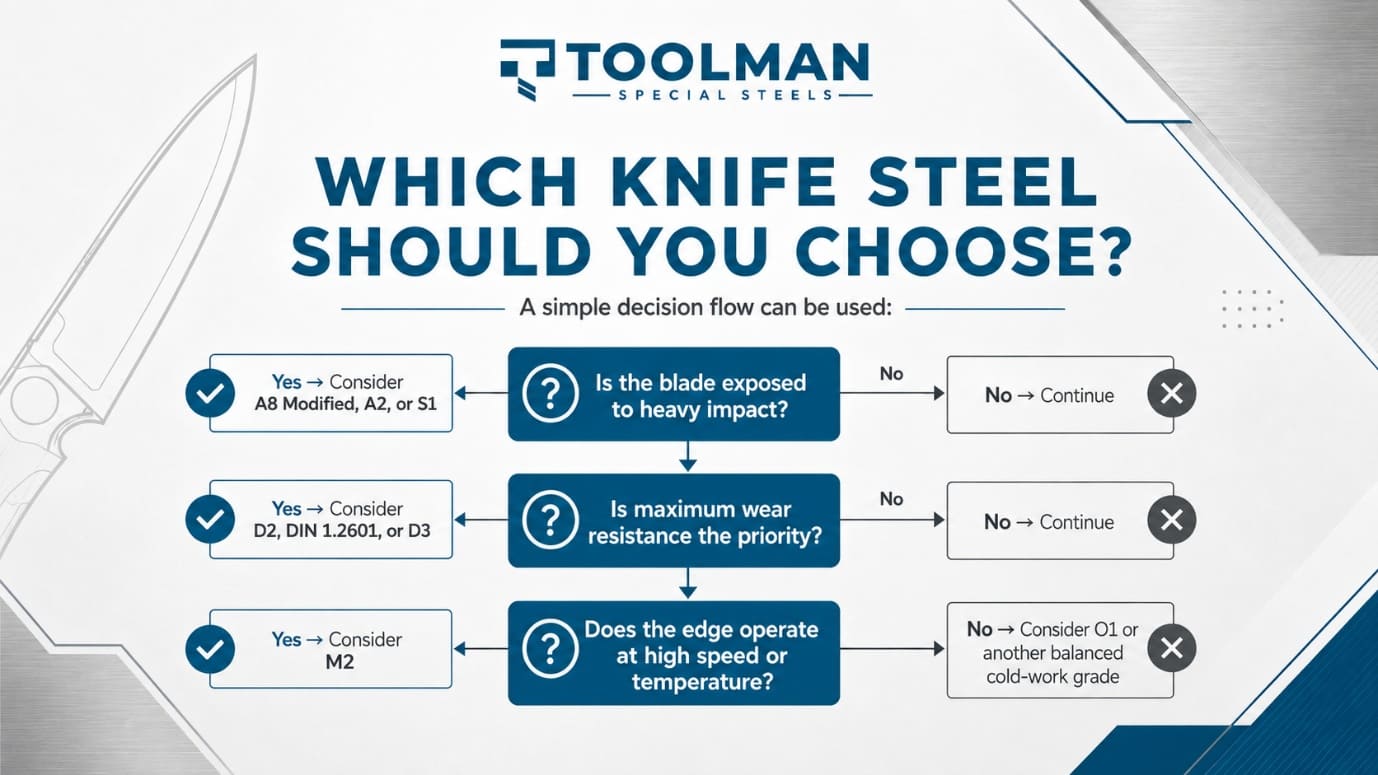
A Simple Grade-Selection Guide
|
Your main requirement |
Grade to evaluate |
|
Wood-chipping or veneer knives exposed to impact |
A8 Modified |
|
Long edge life in abrasive cold cutting |
D2 / DIN 1.2379 |
|
Heavy-duty machine knives with high compressive loading |
DIN 1.2601 |
|
Maximum abrasion resistance with limited shock |
D3 |
|
Balanced toughness and dimensional stability |
A2 |
|
High-impact cutting or woodworking tools |
S1 |
|
General-purpose edge retention and machinability |
O1 |
|
High-speed cutting with elevated edge temperature |
M2 |
This table should be treated as an initial selection guide. Blade geometry, hardness target, section size, grinding method and actual cutting conditions must still be reviewed before finalising the material.
Why Heat Treatment is as Important as Grade Selection
A premium steel grade cannot deliver its intended performance if it is incorrectly hardened or tempered.
Poor heat-treatment control can cause:
- Low or uneven hardness
- Excessive retained austenite
- Distortion
- Decarburisation
- Grinding cracks
- Brittle edges
- Premature chipping
For example, our DIN 1.2601 data recommends soft annealing at 800–840°C, stress relieving at approximately 650°C, hardening at 980–1,010°C and tempering between 150°C and 400°C. The final cycle must still be adjusted for blade dimensions and performance requirements.
You should also stress-relieve heavily machined blades before final hardening and maintain sufficient grinding coolant after heat treatment. Excessive grinding heat can locally soften the edge or introduce cracks even when the steel was originally treated correctly.
Our Manufacturing Range
For D2 and DIN 1.2601, we publish the following manufacturing range:
|
Product form |
Available range |
|
Hot-rolled bars |
8–65 mm diameter |
|
Forged and turned bars |
65.2–500 mm diameter |
|
Forged square bars |
50–500 mm |
|
Flats |
6–410 mm thick |
|
Flat widths |
20–700 mm |
We also manufacture high-speed steel grades such as M2 in rounds, squares and flats for specialised cutting applications.
Final Thoughts
Choosing knife steel is an exercise in balancing competing properties. Maximum hardness may reduce toughness. Greater wear resistance may make grinding more difficult. A highly tough grade may require more frequent sharpening.
At Toolman Special Steels, we help you compare these trade-offs using the actual cutting environment rather than selecting a grade only by reputation. We manufacture cold-work, high-speed, carbon and specialised knife steels, including:
A8 Modified, D2, DIN 1.2601, D3, A2, O1, S1 and M2.
Our knife-steel manufacturing experience includes dedicated production of A8 Modified chipper-knife steel and other cold-work grades within our integrated steelmaking and finishing operations.
Share your blade design and working conditions with us, and you can select a grade that provides the appropriate balance of edge retention, toughness, wear resistance, heat-treatment response and lifecycle cost.
Frequently Asked Questions
Which steel is best for industrial knives?
There is no universal best grade. A8 Modified is suitable for many industrial and wood-processing knives, while D2 and DIN 1.2601 are stronger candidates where abrasive wear and edge retention dominate.
Is D2 suitable for knife manufacturing?
Yes. D2 offers high wear resistance, edge retention and dimensional stability, making it suitable for industrial blades and precision cutting applications.
When should we choose A8 Modified instead of D2?
You should evaluate A8 Modified when toughness and resistance to chipping are more important than achieving the highest possible abrasion resistance. We list it specifically for industrial, wood-chipping and veneer knives.
Can high-speed steel be used for knives?
Yes. M2 is listed for knives and other cutting tools. Its hot hardness and resistance to softening make it particularly useful where cutting speed generates substantial heat.
What information should you share when requesting knife steel?
Share the knife dimensions, cutting material, cutting speed, impact conditions, expected edge life, required hardness, quantity, product form and preferred supply condition.
Ready to upgrade? Contact our team today for expert guidance and support.
Contact